Fictions of Ownership Within Opaque Borders
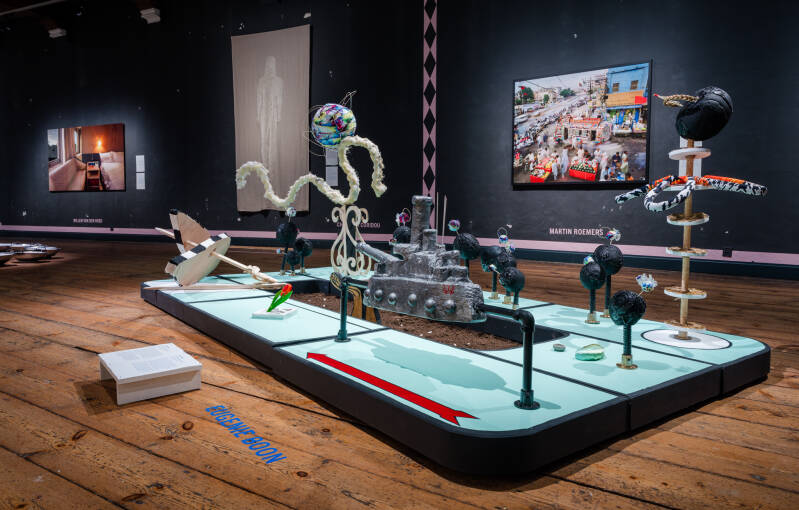
Installation, KunstParade 2023, Museum Prinsenhof Delft
"Fictions of Ownership Within Opaque Borders" is an installation commissioned by Ellen Borger for Museum Prinsenhof Delft in response to the City of Delft’s apology for its role in slavery and the slave trade.
My artistic research over the past years has centred on the relationship between the Netherlands and Curaçao, and on how this relationship continues to shape my own position as an artist. When invited to respond to Delft’s apology, I therefore approached the commission from within this diasporic reality. Curaçao enters the installation both specifically—as the place from which much of my research and visual language originates—and symbolically, as a point from which to consider wider Caribbean and diasporic experiences.
Rather than attempting to speak for these communities, I use my own position as the starting point. I believe artists inevitably reflect something of the realities they inhabit. Mine exists between places, histories and systems of knowledge. Responding to Delft consequently meant placing these realities alongside one another and asking what their relationship might reveal.
Delft’s historical prosperity was not only economic. Trade and colonial expansion also contributed to the conditions through which the city developed its reputation for art, design, craftsmanship, architecture and technical innovation. These forms of cultural production became objects, collections, institutions and eventually heritage. Placing Delft alongside Curaçao led me to a question: where and how do we recognise the creative innovation produced within Caribbean societies shaped by this same history?

Installation, KunstParade 2023, Museum Prinsenhof Delft
I began looking beyond conventional categories of art and design toward carnival, architecture, games, oral storytelling, costume, performance and communal forms of making. These practices contain sophisticated systems of creativity, adaptation and knowledge, even when they have not historically been valued, archived or represented through the same structures that determine what becomes recognised as art, design or cultural heritage.
Through the symbolic world of Pega Saya, the installation brings these different systems into conversation. Pega Saya moves between Curaçao and the Netherlands, folklore and institution, art and craft, economic and cultural value, and individual authorship and collective knowledge.
The visual language of the monopoly game provides another framework for this investigation. The game transforms complex socioeconomic structures into familiar rules of property, borders, accumulation and exchange. Land becomes something that can be divided, purchased and claimed because the players collectively accept the rules through which ownership operates.
n the installation, the game becomes a way of asking how other systems of value might function in much the same way: who establishes the rules through which something becomes valuable, worthy of preservation, or worthy of representation?
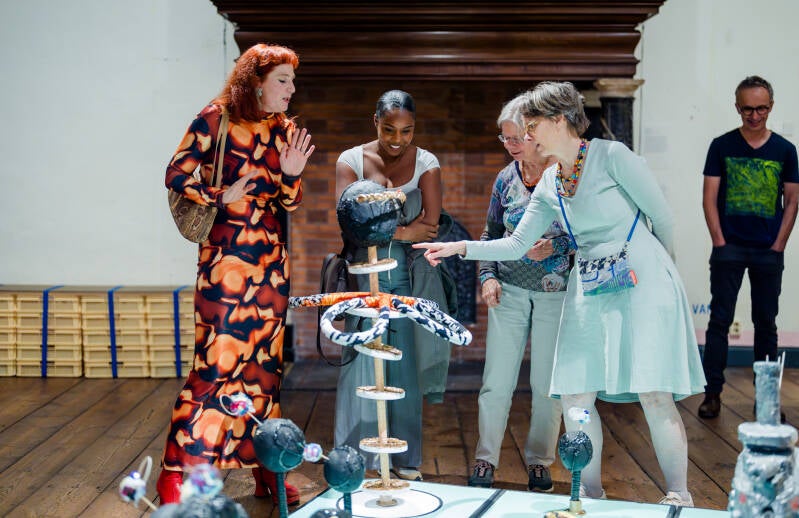
Installation, KunstParade 2023, Museum Prinsenhof Delft
This question became particularly important to me in thinking about the meaning of an apology. If asking for an apology is partly a demand for historical recognition, then what do we hope recognition will look like once it is given? What do we consider worthy of being recognised, and through whose systems of value do we make that judgement?
I am interested in this question not only in relation to Dutch institutions, but also in how we, as island and diasporic communities, respond ourselves. Western institutional models of museums, archives, authorship and heritage do not have to be accepted as universal measures of cultural value. At the same time, my academic background makes me interested in whether some of these structures can be adopted, adapted or reimagined rather than simply rejected: used as tools through which different forms of knowledge can be preserved, transmitted and valued on our own terms.
The “opaque borders” of the title therefore extend beyond geography. They are the often invisible boundaries between art and craft, innovation and tradition, ownership and collective inheritance, institutional knowledge and lived knowledge, and between who is recognised as a producer of culture and who remains outside its official histories.
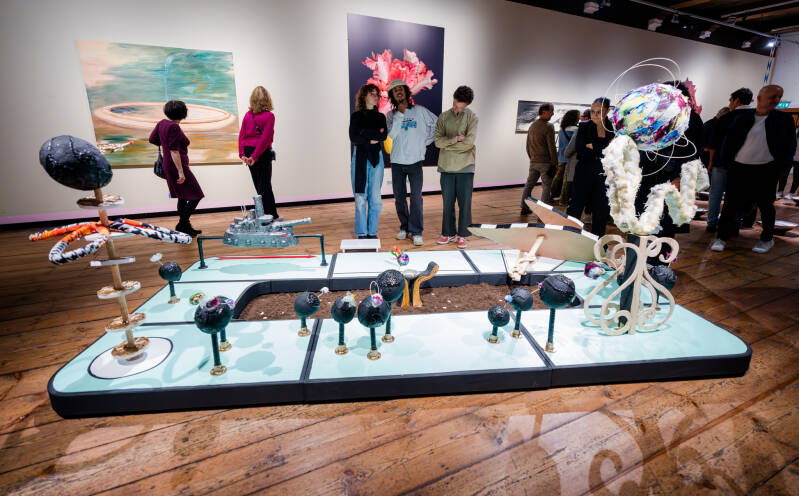
Installation, KunstParade 2023, Museum Prinsenhof Delft
"Fictions of Ownership Within Opaque Borders" does not attempt to resolve these questions. Instead, it uses play, symbolism and cultural memory to create a space in which different systems of value can meet. The work asks what might come after acknowledgement: not only who gets recognised, but what we ourselves choose to recognise, preserve and carry forward as culturally valuable.


Commisioned Artist presentations, TU student Lars Geluk (Harderwijk, 2000) & Marije Vermeulen (Delft, 1976)


Overview exhibition with works of Tony Monsanto & Yubi Kiringdongo